

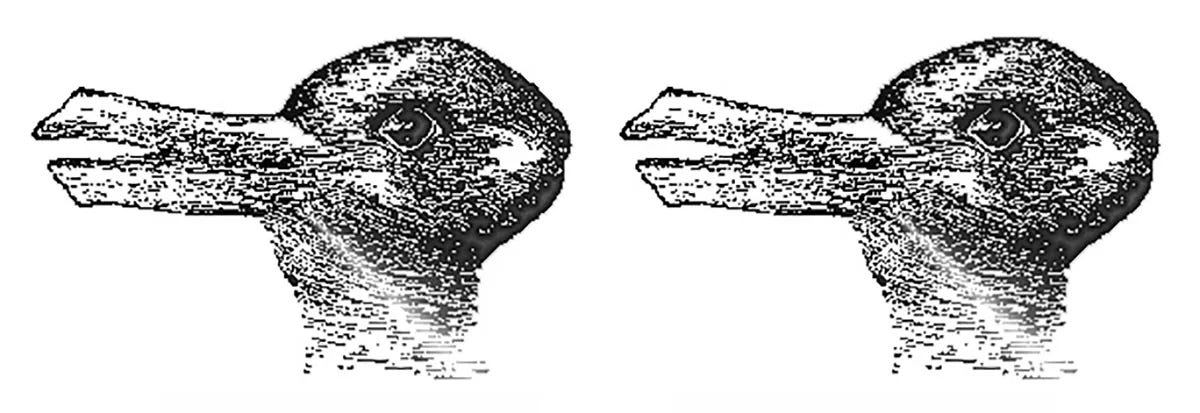
In July 2024, shortly after the disastrous Biden-Trump presidential debate, left-wing political commentator Matthew Yglesias published an article titled “I was wrong about Biden.”
He wrote that for the past few years, he had been really convinced that Biden was sharp and with it. To explain how he could have gotten this issue so wrong, he used the metaphor of that old optical illusion of the rabbit and duck.
Before the debate, Yglesias said, he saw a rabbit: a president who gave a strong State of the Union address, sat for an hour-long interview with Howard Stern, etc. Because our brains have a hard time seeing the rabbit and duck at the same time, this view of Biden caused Yglesias to ignore or sweep under the rug evidence that Biden was really a duck (skipping the Super Bowl interview, rarely sitting down with journalists for in-depth interviews, etc). It wasn’t until after the debate, when Yglesias’s brain could no longer pretend that Biden was a rabbit, that he saw the duck.
A lot of people have pounced on Yglesias (as well as a raft of other left-leaning reporters and political commentators who all claimed that Biden was a rabbit), demanding to know why they didn’t see the duck. Interpretations and justifications range from a fractured media environment (these reporters never saw evidence that Biden was a duck), to the White House carefully managing Biden’s image, to the idea that most of these folks were in the tank for Biden.
There’s probably some truth to each of these explanations, but I also wonder if there’s a simpler and deeper—and more universal—explanation.
I have my own story of rabbits and ducks.
I used to be close to a guy who I was convinced to my bones was a rabbit. The reason I was so convinced was simple: I really needed a rabbit in my life. And so when I watched him behave like a duck towards me or towards people I cared about, my brain found elaborate ways to ignore, whitewash, or sweep under the rug those aspects of his personality.
Eventually I woke up and realized the truth: this guy was mostly duck. But I was only able to see that once my psychology changed such that I no longer needed him to be a rabbit in my life.
Maybe Yglesias and other left-wing political commentators and reporters were so terrified of the GOP and of the possibility of Trump 2.0 that they really needed Biden to be a rabbit. And what they needed to be true, their brains provided evidence for.
If that’s true, then it means that the reason we had a mentally unfit leader of the free world for several years is not naked corruption, or a fractured media environment, but—fear.
It all reminds me of one of the better explanations I’ve heard for why Trump got elected and re-elected: his voters know that he’s a fighter.
A lot of Trump supporters voted for Trump because they feel like they’re losing the country they love. A recent report from More In Common that analyzed the Trump coalition found that 87% of Trump voters agree that “Open borders, crime, and homelessness have pushed this country into crisis.” Many of them have suffered as globalization hollowed out their factory towns, as unauthorized migrants flooded their communities, as the opioid epidemic took friends and loved ones. And instead of feeling understood in their pain, many of them felt kicked and spat on by the left. The same More In Common report found that only 21% of Trump supporters agreed with the statement: “Democratic politicians respect people like me.”
When people feel like they’re being beaten and insulted when they’re already down, they’ll hire a fighter to protect them—and the fightier, the better.
So the left’s fear of the right gave us a massive cover-up and an existential danger to our world order (as Atlantic writer Tyler Austin Harper said of Biden, “It is not acceptable for a man who has some good days and some bad days to control the nuclear codes.”). The right’s fear of the left gave us Trump.
I think if we want to restore our democracy, we have to stop being the reason that people across the aisle are scared.
What does that look like?
It might look like not dunking on the other side on Facebook or on X/Twitter, and instead trying to genuinely understand where they’re coming from.
It might look like reaching out to that person across the aisle whom we know is in pain.
It might look like having a thoughtful conversation with someone who voted differently than you did about your perceived differences (Braver Angels, the national depolarization nonprofit, actually offers structured 1:1 conversations with thoughtful folks of different backgrounds. I’ve done a few and they’re amazing.)
It might look like being willing to call out what we see as the insanity and overreach on our own team. If you’re on team X, you might be surprised by how much criticizing what you see as the overreach of X can make people on team Y feel safe and understood around you.
If we can stop being the reason that our political opponents feel scared, and start being the reason that they feel safe, then I think we stand a good chance of rebuilding our faltering democracy.
Heal the West is 100% reader-supported. If you enjoyed this article, please consider upgrading to a paid subscription or becoming a founding member. I greatly appreciate your support.
I am vehemently opposed to Trump, but I talk to Trump supporters every opportunity I get. I can't explain it, but I always come away from these conversations, when they're respectful and thoughtful (had two in the past month!), feeling high on life.
I think it's because instead of sitting in rage at the insanity (to me) of their support, I understand what drives them, even if it's clear we value different things. I also feel good about myself because I hopefully changed their perspective a little bit on liberals, too (that might be wishful thinking though).
ICYMI, you might be amused by this old meme of armies battling over their Duck and Rabbit Gods:
https://share.google/KllFV4krzEbXKeh0s