

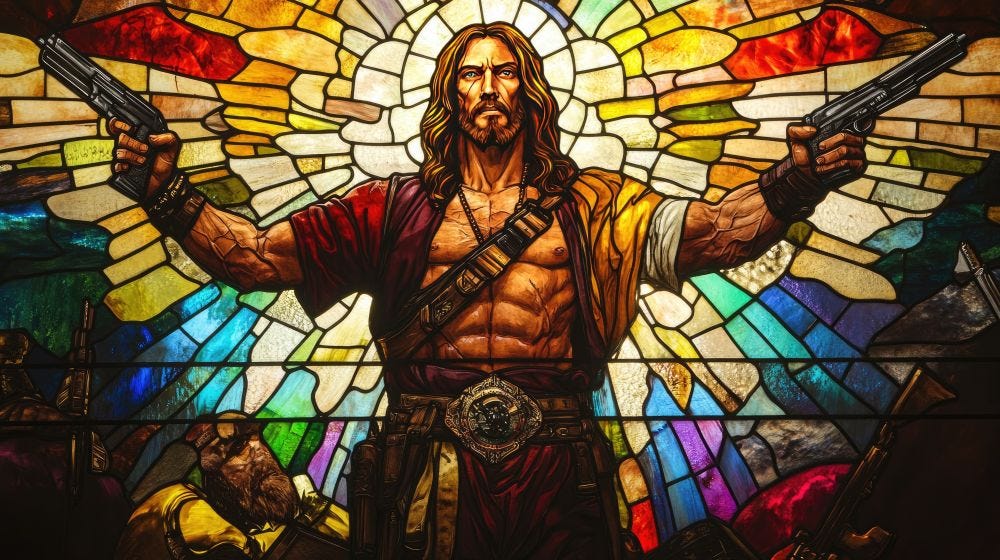
There’s something about “muscular Christianity” (essentially, everything from medieval popes who acted like earthly kings, to a video from the recently-renamed Department of War in which Pete Hegseth intones the Lord’s Prayer over images of aircraft carriers and bombing runs) that turns my stomach.
I don’t mean that supporters of these folks turn my stomach. I know lots of wonderful and deep Christians who are Trump supporters. I mean: whatever else one may think of the Trump administration, there’s something about employing Christianity as a buttress for aggressive wars that runs contrary to how I see my faith.
Which got me thinking: what do I think of as the essence of my Christian faith? God is infinite, and summing Him up in a single sentence (or even ten thousand sentences) would be impossible; but in my own life, what do I see as the cornerstone of Christianity?
I think it comes down to a willingness to surrender. I’ve been especially drawn lately to Matthew 16:25: “For whoever wants to save their life will lose it, but whoever loses their life for me will find it” (NIV).
I think this surrender comes in two forms: vertical and horizontal. We surrender our lives, our will, and our treasure to God (vertical); and we surrender our lives, our will, and our treasure to each other (horizontal).
Vertical
I love how Richard Foster puts it in Celebration of Discipline:
“The first act of submission is to the Triune God. At the beginning of the day we wait, in the words of the hymn writer, ‘yielded and still’ before Father, Son, and Holy Spirit. The first words of our day form the prayer of Thomas à Kempis, ‘As thou wilt; what thou wilt; when thou wilt.’ We yield our body, mind, and spirit for his purposes. Likewise, the day is lived in deeds of submission interspersed with constant ejaculations of inward surrender. As the first words of the morning are of submission, so are the last words of the night. We surrender our body, mind, and spirit into the hands of God to do with us as he pleases through the long darkness.”
In my own life, I tend to fluctuate between two ways of being. The first is where I prioritize my own will. On these days I tell God, essentially: “I know there are things you want to do with me today, but I have work to do first. Maybe I can listen to you after?” On these days, I try and fit God around the tasks of my day-to-day; to let Him fill in the cracks, so to speak.
These days are generally disasters.
Partly, of course, that’s because God is much wiser than me. There’s something profoundly silly about telling the maker of the universe, in essence: “I’m going to ignore Your plans for me today, because I know best.”
But I also think these days are so rough because I’m starting from the wrong baseline assumption. The truth is that my life, like my time and my treasure, are not my own; they belong to God. When I act as though these things belong to me, I become selfish and irritable. My own self-centeredness crowds God out.
By contrast, my days go much better when I work to adopt the mindset that Richard Foster describes above. When I surrender my will and my day to God, I find that the truly important things get done. More to the point, I find myself much closer to the Divine than I would otherwise be.
A pastor once told me that there are two ways for us to see God: as an incredibly gifted secretary who can help us to accomplish our own ends, or as the master of the universe whose ends ought to be all that we focus on. I want to live my life the second way. Muscular Christianity strikes me as way too much of the first way; it is the temptation, not only that I am trying to avoid, but that I think all of us ought to try and avoid.
Horizontal
The second type of surrender is horizontal: I think we are called to be willing to surrender our lives, and everything in them, in order to serve one another.
To be clear, this is not something at which I pretend to be perfect. I can be self-obsessed and self-centered. As one example among many: I’m pretty good at tithing my time, but I’m not at all good at tithing my money.
But with that said, whenever I do surrender of myself in order to serve another human being made in God’s own image, it brings me much closer to God. Saint Theresa of Avila said that we are called to do two things with our lives: to love God, and to love each other. Of these, she said, the better metric for determining the depth of someone’s faith was how well they loved their fellow man.
Again, this runs headlong into muscular Christianity. If the purpose of our lives is to serve, then in muscular Christianity I see something different: a faith that says that the purpose of others is to serve us. That feels theologically dangerous, not least because I can see how it tempts my own heart.
To me, the essence of Christianity is not proper doctrine, or proper liturgy, but proper heart posture. The most salient question, to me, is: “Who is my life intended to serve?” If the answer is God (and through God, all of the human beings with whom we interact who are made in His own image), I think we’re on the right path. When the answer is ourselves, I think we’re in hotter water than we may yet realize.
Heal the West is 100% reader-supported. If you enjoyed this article, please consider upgrading to a paid subscription or becoming a founding member. I greatly appreciate your support.
This is a nice thoughtful article in many ways, but I'm curious. What does it mean to follow God's will instead of your own? How do you tell what God wants from you. Is there a voice in your head that you identify as his? And how can you tell that voice isn't just another aspect of yourself?
Very true. Feel good Chritstianity is on the rise, no repentance, no change, just say some words, It is all about feelings.