

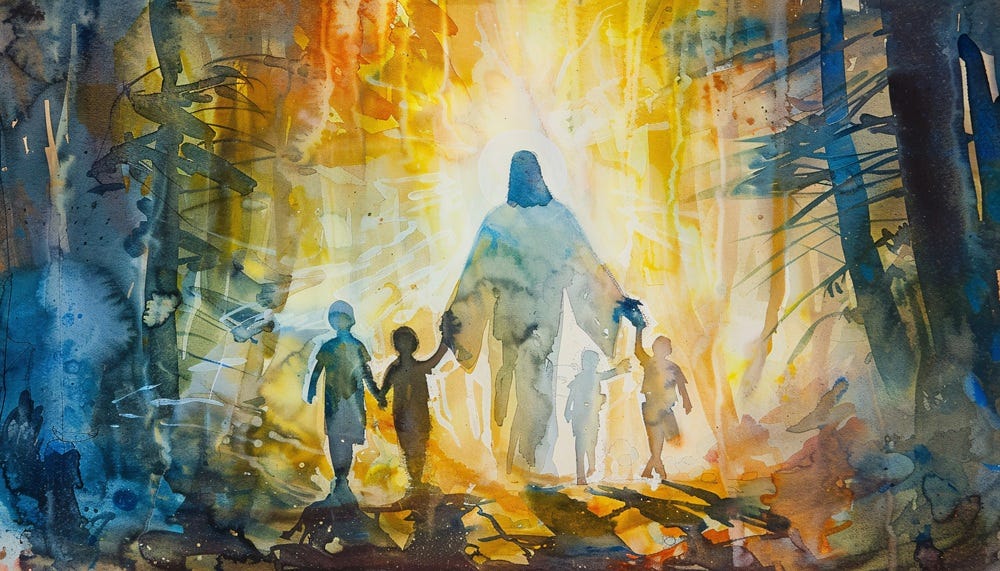
I’ve been rereading the Harry Potter series, which is one of my favorite stories of all time. It’s also a very Christian story. J.K. Rowling actually said that she didn’t disclose her faith while she was writing the story because she worried that said disclosure would make the ending (a man dying for everyone he loves, and then coming back from the dead to defeat evil) too easy to guess.
But the theme that moves me the most isn’t how Harry grows up to die for the world and so save it. Instead, it’s how Harry is treated in the very first book.
For the first ten years of his life, of course, Harry is horribly mistreated by his aunt and uncle. He’s an orphan who is bullied by his cousin and is locked in a closet for the most minor of offenses. And then a half-giant named Hagrid shows up and invites Harry into a brand new world.
Two things about this aspect of the story stand out to me.
First, Harry is as welcome in Hogwarts as anyone else. Headmaster Albus Dumbledore doesn’t care that Harry’s an orphan, or that he was raised in an awful home, or that he’s never had a real friend. Dumbledore welcomes Harry into Hogwarts the exact same way that he welcomes everyone else. In this magical new home, Harry’s former status as an outcast is never held against him (well, not by any of the good guys, anyway).
Second, there’s the sheer lengths to which the magical world goes to track Harry down. When Harry first gets a letter inviting him to attend Hogwarts, Uncle Vernon destroys it. So more letters come. This time Vernon boards up the mail slot. Then he boards up the entire house. So letters come smuggled in the weekly delivery of eggs. Eventually Vernon moves the whole family to a tiny hut on a remote island in the middle of a storm to try to stop the magical community from reaching Harry. But even that doesn’t work. At exactly midnight on Harry’s birthday, Hagrid knocks down the door of the hut to tell Harry about his invitation into a new life.
I think this story highlights what I see as two of the most wonderful things about God.
First, God doesn’t care a whit about our past. He doesn’t care if we’re the loneliest, most miserable outcast eking out a living on the margins of society. He doesn’t even care if we’re in this position entirely due to our own mistakes. He welcomes us into His kingdom anyway.
Second, He is completely obsessed with tracking us down. I’ve seen this in my own life. I had a pretty rough decade before I became a Christian. I spent a lot of time wanting to die. I spent a lot of time hating God. I seethed with anger towards any being who could have presided over the worst parts of my life. But through it all, God kept loving me. Patiently and tenderly, He showed Himself to me in whatever small ways I was willing to accept. Over and over and over again.
In Experiencing Father’s Embrace, Jack Frost tells the story of how he ran away from home when he was a teenager. His father eventually found the drug-addled store where Jack now lived and drove there every single day, hoping to see his son. Jack had his issues with his father, but that daily act of love stuck with him. Eventually they were reconciled.
Jack tells that story to illustrate a simple point: if his own father, flawed as he was, spent so much time and effort trying to show Jack that he still loved him, how much more does our heavenly Father pursue us? How much more does the One who made us endlessly track us down, not to override our free will but simply so that we will know how much He cherishes us?
I’ve been lucky enough to know many deep Christians in my life. But probably the most touching Gospel moment came courtesy of a friend I knew from high school. This woman moved to a different state after high school, but for years every Christmas she would come home to be with her family.
And every Christmas she would invite me to be with them.
These invites meant the world to me. At this point my folks had moved to another state, and holidays were very difficult for me. I suffered from intense depression and an addiction to pornography. I was single and very lonely. I looked like a success on the outside—that is, I had a good job and I could pay all of my bills. But on the inside I felt like an outcast. I remember bitterly wishing, so often, that I could just trade lives with almost anyone else.
Those Christmas invitations made me feel welcome. As awful as I felt so much of the time, those invitations made me feel, just for a few hours, like I might actually belong.
I suppose they were my first taste of what life with Jesus is really like.
P.S. the title is a reference to one of my favorite Christian songs, So Will I (100 Billion X). If you haven’t heard it before, I highly recommend giving it a listen.
Heal the West is 100% reader-supported. If you enjoyed this article, please consider upgrading to a paid subscription or becoming a founding member. I greatly appreciate your support.
Love this! God really doesn’t stop chasing us. This makes me feel much for faithful in my own current struggles as I know He won’t give up on me.
And it reminds me that He wont give up on my friends who have abandoned the faith. Despite their (often understandable) anger towards the humans who have wronged them, I pray that God is able to show them He is different.